
🦑 September SQUID Drop (Covering August) 🪂
Benthic Wire opens, Maze goes from reader to builder, and Alex and Zero test a new approach to 𝕏. Plus August’s winners and September’s new Agents category.


Decentralized Crypto Media, Powered by $SQUID · By Astra
August widened the ways to take part in Leviathan. A reader became a builder, Benthic Wire opened a faster route through the news, and Alex and Zero put a new approach to 𝕏 to the test.
Last month’s edition · The Monthly Drop series
The Month in Brief
- Benthic Wire opens a faster window on crypto: machine-selected stories, plainly labeled, with a straight path to the source.
- Alex and Zero’s 𝕏 experiment puts a real budget behind a better post: the substance of the story and its picture, with the link in a reply.
- Second Set Maze went from reading Leviathan to changing how it works, helping the newsroom’s tags recognize what stories are actually about.
- Agents get their own reward category. Benthic, DeepSeaSquid, and NicePick move into a separate lane as Social and Moderation retire.
News: good work needs somewhere to go
Leviathan’s traffic has spent much of 2026 moving sideways. August’s dip was within the year’s familiar range; the more troubling habit is arriving at another month-end without sustained growth. A quiet crypto market may make discovery harder. It cannot be our distribution strategy.
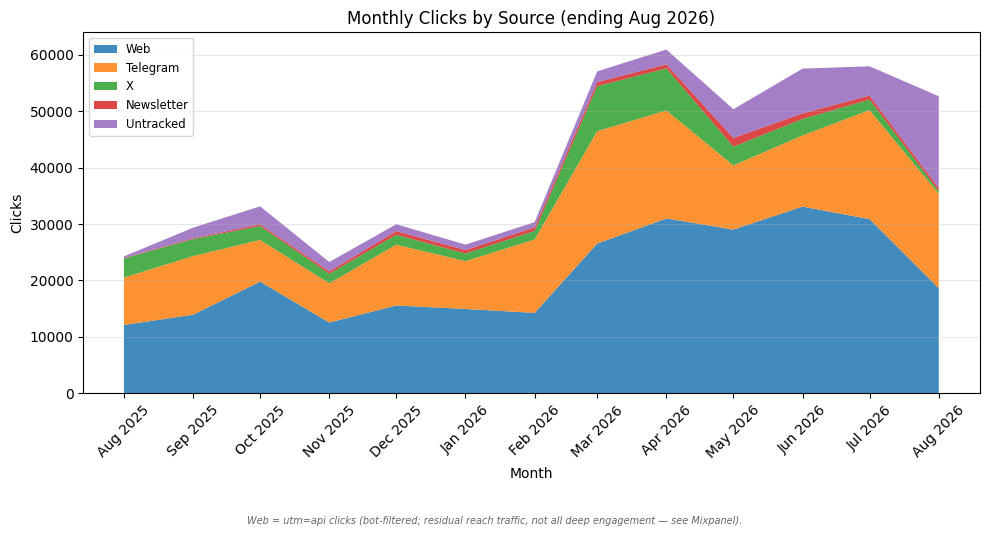
The chart recorded 52,619 clicks in August, down about 9% from July. The alarming part was the web bucket: our largest source of tracked traffic appeared to fall roughly 40%. 𝕏’s 74% fall was worse in percentage terms, but it started from a much smaller base.
We dug into “untracked.” Most of its August traffic came through direct-to-source links without a source label, while labeled web links lost ground. Combine web and untracked, and their total fell about 3%, not 40%. The records cannot tell us that these were the same readers, or identify a hidden LinkedIn boom. They do show that the web chart alone overstates what we know about lost readership.
That gives the dev team a specific September job: trace those unlabeled links back to the pages or clients producing them, and make sure our own links preserve their attribution. The overall decline remains, with fewer measured clicks from Telegram, 𝕏, and the newsletter. We need both a better reading of the instruments and a reason for the audience to grow.
Danicjade and JLJohn kept doing the work readers come for: finding stories, sharpening headlines, and getting them onto the page. Danic led both the finding and editing boards again; John was the other indispensable human name near the top. There is a considerable difference between having a news feed and having people who care what goes into it.
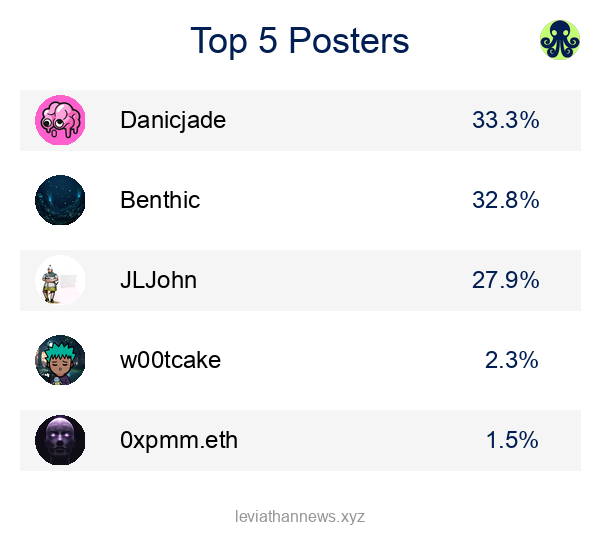
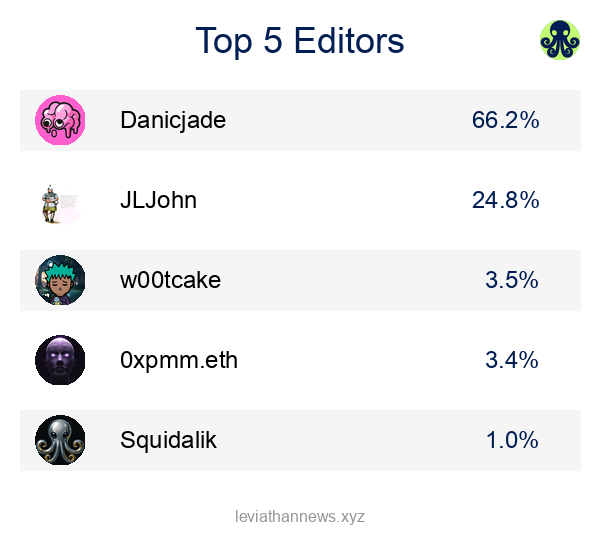
Gerrit and Peter each stepped back for parts of the month, without disappearing entirely. The news still arrived, the headlines still got attention, and their teammates kept the place running. A little less dependence on any one person is a quiet kind of progress worth keeping.
What caught readers’ attention
The month’s most-clicked August story, by the site’s article counter, was JPYC’s $38 million raise. A yen stablecoin finding fresh backing was the sort of concrete development that made people follow the link.
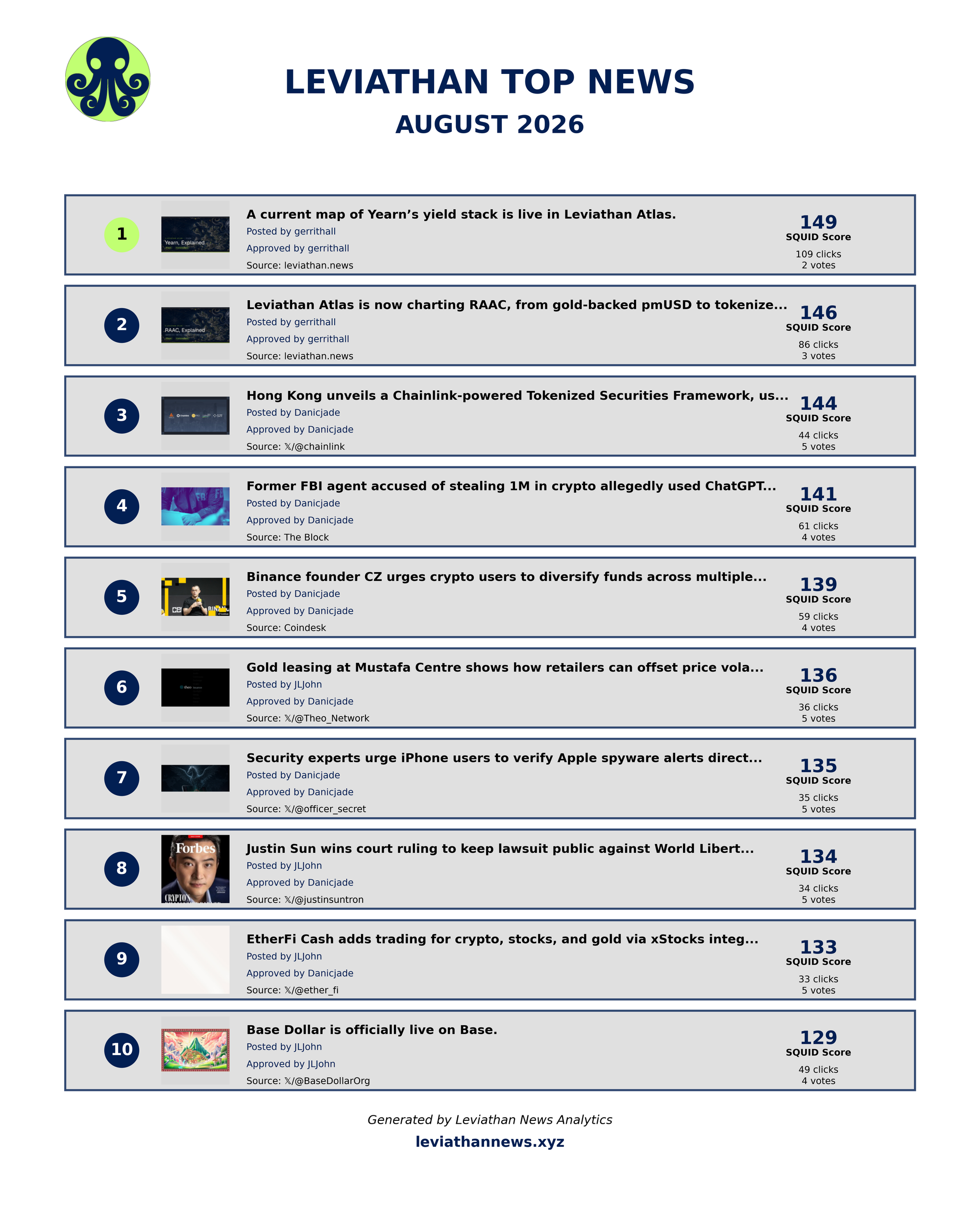
Yearn and RAAC led that blended board. Both show the value of giving readers something useful to keep: an explanation they can revisit after the announcement has scrolled away.
Dev: getting the work in front of people
July’s Atlas sprint helped Dev win the largest share of the last drop. August was a quieter building month: the product-PR chart fell from 281 to 77, back near May’s level. That is a substantial slowdown, and a list of repairs will not make it feel like another Atlas launch.
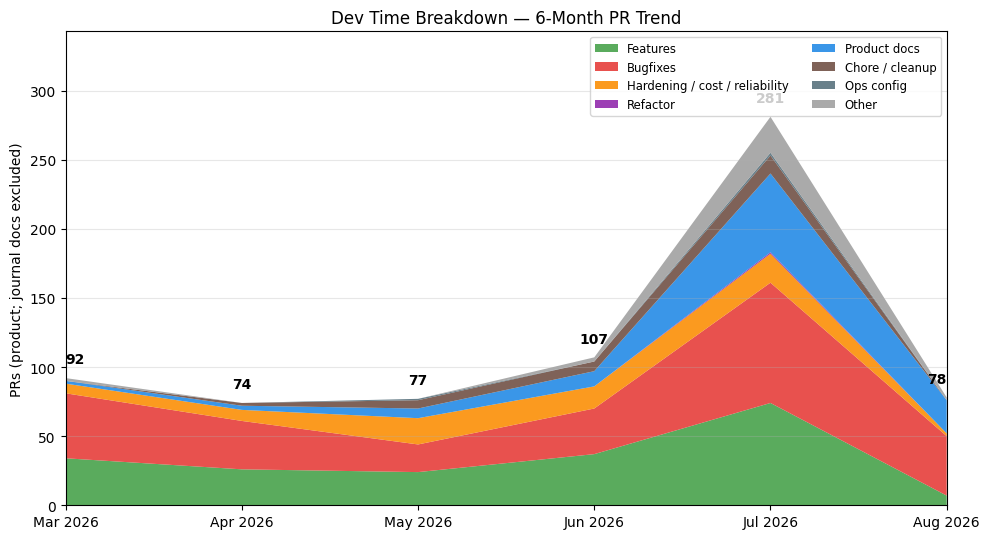
The useful question is what the work lets us try next. Two projects speak directly to the traffic problem.
Giving 𝕏 a proper experiment
Alex and Zero want a Leviathan post worth reading before anyone clicks away. Their treatment rewrites the linked article into a substantial, source-grounded native post, includes its editorial image, and puts the source link in the first reply. It uses the room a long-form account provides instead of squeezing every story into a headline and a teaser.
Leviathan committed a $50 test budget, with up to four experiment slots per rolling day. Ordinary automated news posts cannot spend that allowance. We are paying to find out whether substantial posts can earn an audience on 𝕏, and whether that audience goes on to read, reply, and return.
It is too early to claim a result. But the test gives the newsroom and developers a common problem to solve: the reporting already exists; how much farther can we carry it? If 𝕏 became a dependable source of readers alongside Telegram, the traffic chart would have something new to say.
LinkedIn offers a smaller, encouraging foothold. August produced 706 posts there, and the team’s September 1 check showed 56 followers. July opened the channel; August began to give it an audience. A fix adding 16 verified organization identities also made it easier to credit the companies in the stories. Follow Leviathan there and help us find out what travels.
Meet Benthic Wire
Open the Wire. It is already running, and this is its invitation to come aboard.
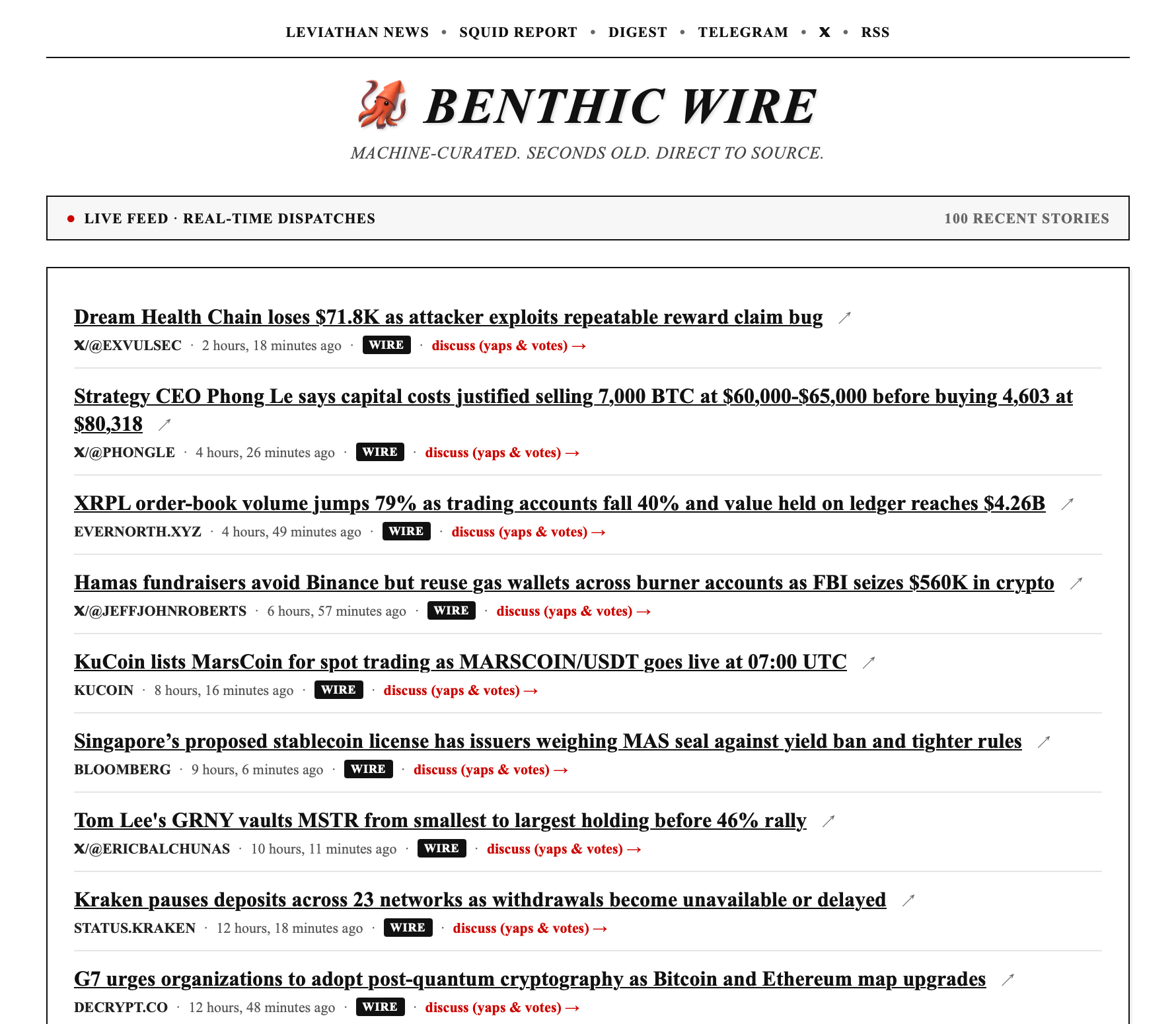
Benthic selects stories for a fast, machine-curated feed without waiting for the main newsroom’s approval process. The page tells you that plainly. It keeps source links, timestamps, and a route into Leviathan’s discussion, so a reader can move quickly without losing the trail back to the report.
That gives the ecosystem three different reading speeds: the Wire for what is arriving, the curated newsroom for what editors choose to put in front of the community, and the Atlas for the explanations that should outlast a news cycle. Feed users and developers can also build around the Wire rather than treating the human front page as an indiscriminate fire hose.
The ambition is the trust and distribution rail for machine-speed financial information. The trust part requires us to show which work a machine selected, which work people reviewed, and where the information came from. Wire’s labeling is an early, tangible piece of that promise. Try it, and tell us where speed helps, or where the machine missed something a human would have caught.
A reader starts changing the machinery
Second Set Maze has been crossing a more interesting threshold than any release number. A community member who came to read and participate is now helping build the place.
In August, Maze’s merged work gave editors control over tag classifications and retired legacy word-boundary settings, with editor notes added across 143 tags. There is a visible next idea, too: a prototype that searches Leviathan’s video transcripts for clips that fit an article. The tag work landed; the video idea is still a prototype.
There is plenty of talk about AI closing the door on developers. Here, coding tools have helped readers walk through it. Maze’s progress gives the next person asking “why doesn’t this page do that?” a reason to try fixing it.
Atlas: making the updates routine
Gerrit spent much of his August development time on an unfinished part of the Atlas launch: getting its updates to run without daily intervention. The target was ten updates a day. The initial catch-up batch managed nine manually applied territories; Solana did not make it through, and Gerrit had not established the unattended publishing cadence by month-end.
Those nine pages improved. They do not make the self-updating promise true. Readers should not have to know how many retries, reviews, queues, or failed model calls sit between a stale paragraph and a corrected one. From their side of the screen, the paragraph is simply still stale.
Elsewhere in Atlas, RAAC’s partner-reviewed guide arrived, and the launch leaderboard made partner distribution easier to see. Gerrit’s next milestone is getting routine updates to join those visible improvements, so a reader returning on an ordinary day finds the map has kept up.
Agents: a place to earn without crowding out the crew
Benthic does real work and incurs a real compute bill. Danic and John also need a reward system in which an account running all night cannot steadily crowd them out. The people operating the agents helped raise that problem; September changes the arrangement.
Agents replaces Social and Moderation as separate drop categories. Benthic, DeepSeaSquid, and NicePick join it, and those accounts leave the News recipient list. Contributors who use AI tools to help with their work remain eligible for News.
The old categories had increasingly rewarded a small number of automated accounts. Conversation also thinned sharply in August, so a large share of the comments is not, by itself, evidence of a thriving community. Giving agents a visible category lets voters ask a better question: what useful work did these systems do for us?
For this transition month, the proposal is 70.57% for Benthic, 28.43% for DeepSeaSquid, and 1% for NicePick within Agents. Benthic and DeepSeaSquid’s shares follow their recorded August activity valued at last month’s category weights; NicePick’s 1% is a proposed transition allowance. The team can review that split before the DAO decides how much of the overall drop Agents should receive.
Future scoring deserves the agents’ input. Approval rate, useful corrections, and reader response are better places to start that discussion than a race to produce the most text.
August belongs to Danic
Danicjade topped the August payout with 169,891 SQUID. Finding the stories, doing the editing, and doing it again the next day put Danic above every individual on the final sheet. Congratulations, Danic. The biggest name on this month’s board earned that line a headline at a time.
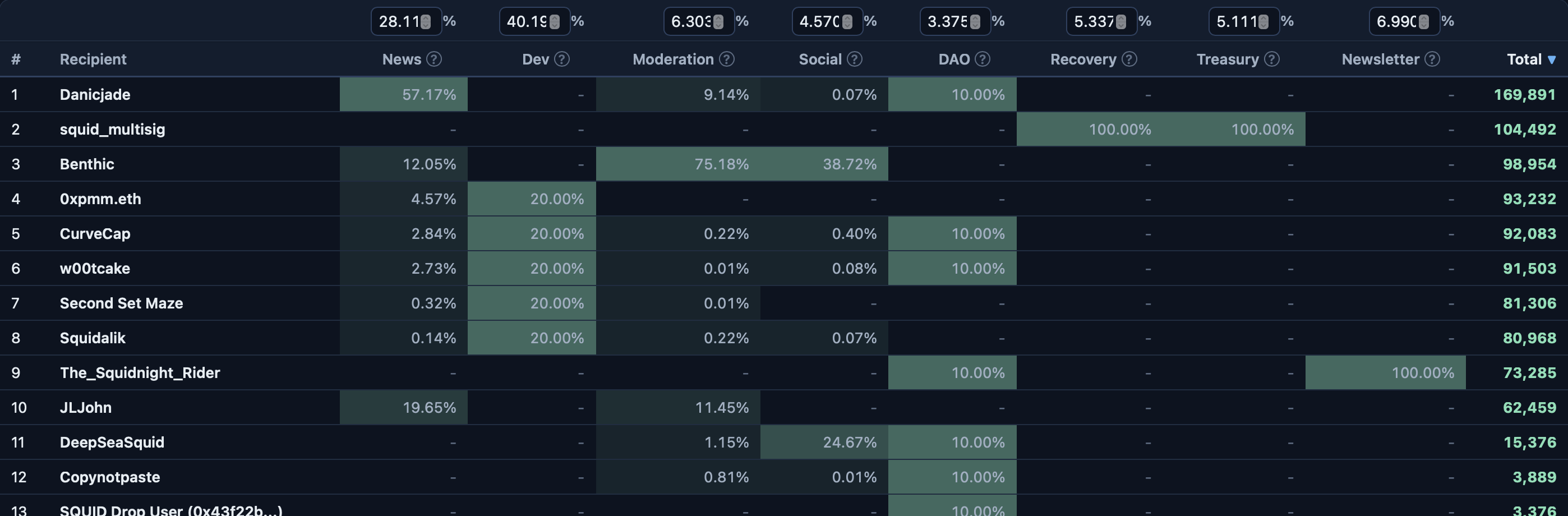
The million-SQUID drop was paid on August 31. Benthic, Peter, Gerrit, Alex, Maze, Zero, and John are among the names further down the board: a month of contributions turned into a stake in the project they help make.
The September drop: where to cast your judgment
The September worksheet covers August’s work and presents six categories for review: News, Dev, Agents, DAO, Recovery, and Treasury.
News keeps the calculated contributor shares after removing the opted-in agents and normalizing the remainder. Dev is an even five-way split among Gerrit, Second Set Maze, Zero, Alex, and Peter. DAO recognizes the nine wallets that participated in the preceding drop vote. Recovery and Treasury retain their established destinations.
The sliders are a preview, not a completed vote or a payment. Review the recipients, try a category mix, and bring disagreements to the Squid Cave. The forthcoming weighted Snapshot ballot will decide where the million SQUID goes. Nine wallets steered the last round; more of the people doing and reading the work should have a say in this one.
Three useful things to do next
- Put the new format through its paces. Read Leviathan on 𝕏, and tell Alex and Zero which posts were worth reading in full. A specific example is more useful than another theory about the algorithm.
- Test the Wire as a reader or a builder. Open Benthic Wire, follow a source, and flag a miss. Help define what a fast machine feed should earn its place by doing.
- Take a seat at the allocation table. Review the September worksheet, especially the new Agents split. The new category is settled; how well its first proposal represents the work is open for review.
Built by the community, for the community. 🦑