
The Stablecoin Wars Heat Up

Tether’s “Made in America” USAT vs Coinbase’s Yield-First USDF
On Monday, the stablecoin market got a lot more interesting. Tether, the company behind the $100B+ USDT juggernaut, launched USAT, a federally regulated stablecoin designed specifically for the US market under the new GENIUS Act framework. Hours later, Coinbase quietly dropped USDF, a new stablecoin that immediately sparked debates about whether America's largest exchange is positioning to divorce its longtime partner Circle.
Tether Goes Legit (Sort Of)
USAT represents Tether’s first product built explicitly for US regulatory compliance. Issued by Anchorage Digital Bank, a federally chartered crypto bank, with reserves custodied by Cantor Fitzgerald, it’s designed to check every box the GENIUS Act requires.
The messaging is unsubtle: this is dollar dominance, crypto-style. Tether CEO Paolo Ardoino has been on a media tour positioning the company as a future “gold central bank” in a post-dollar world, while simultaneously launching a product that explicitly reinforces dollar hegemony. The contradiction is very on-brand.
USAT went live immediately on Bybit, OKX, Kraken, Crypto.com, and MoonPay. The infrastructure is ready. The question is whether institutions, particularly American ones who’ve been wary of Tether’s offshore structure, will actually use it.
Coinbase’s USDF… a Custom Stablecoin?
USDF is part of Coinbase’s “Custom Stablecoins” framework launched in December 2025, which enables institutions to issue branded, dollar-backed tokens collateralized 100% by USDC. In other words: it’s a USDC wrapper with extra steps. The stablecoin is developed by Flipcash and currently in backend testing on Coinbase Exchange, with public access expected in early 2026.
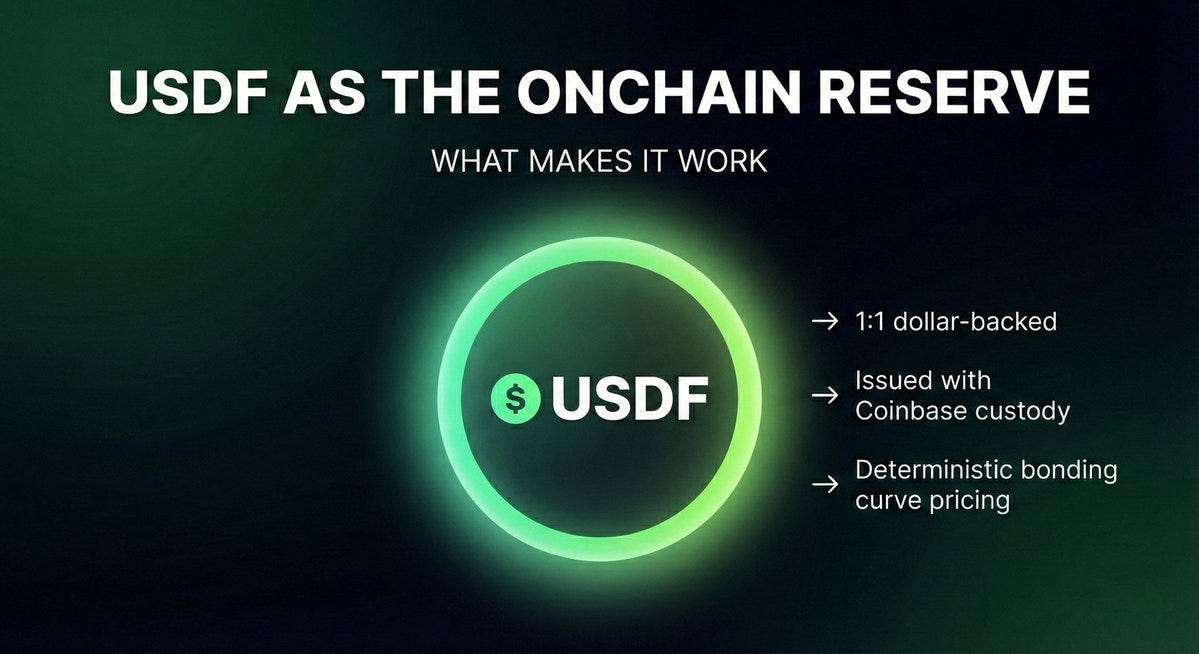
The yield mechanism is the key differentiator for Coinbase, who earned $332.5M from USDC reserves in Q4 2025 alone, up 38% quarter-over-quarter. With USDF, those economics flow more directly to Coinbase and its institutional partners rather than being split with Circle.
The Divorce Theory
The USDF launch was messy. The stablecoin depegged twice within hours of launch, prompting immediate criticism from CT observers. But the bigger story isn’t the technical hiccups, it’s what USDF signals about Coinbase’s relationship with Circle.
The LobsterDAO crowd was characteristically blunt. EzR3aL noted: “USDF just looks like a useless wrapper.” charliemarketplace.eth suggested it signals Coinbase preparing to de-emphasize USDC: “Existential risk for USDC if Coinbase flips a switch to prioritize yield on their coin.”
Coinbase and Circle’s relationship has been rocky since their consortium structure unwound. A Coinbase-native stablecoin that captures yield directly, rather than splitting it with Circle, would make obvious business sense, even if it fragments liquidity. If Coinbase starts steering users toward USDF for the yield benefits, Circle loses both volume and its biggest distribution partner.
What It Means
The stablecoin market is splitting into distinct segments:
- Yield-first (USD.AI, USDe, syrupUSDT): Designed to capture yield for users willing to accept credit risk.
- Compliance-first (Tether’s USAT, USDC, USDF): Built for institutions who need clean regulatory stories, even if yields are lower.
- Decentralized (Polaris, Liquity, MakerDAO): Still relevant for users who want code-enforced guarantees without counterparty risk.
The next few months will show whether USAT gains institutional traction or USDF’s pull users away from vanilla USDC. But the fact that Tether, historically the poster child for offshore crypto opacity, is now launching federally regulated US products tells you everything about where the market is headed.
ROUNDUP: Stablecoin Ecosystem
Standard Chartered Warns Stablecoins Could Drain $500B from US Banks
Standard Chartered research published this week warns that stablecoins could shift $500 billion out of traditional US bank deposits by 2028 — roughly one-third of the projected stablecoin market cap. The supply has already grown 40% year-over-year to over $300 billion, and the bank expects acceleration as crypto legislation like the GENIUS Act advances.
The math is straightforward: if stablecoin supply hits $1.5 trillion by 2028 and one-third comes from bank deposits, that’s half a trillion dollars exiting the traditional banking system.
Polaris Emerges from Stealth with Decentralized Stablecoin Infrastructure

TokenBrice’s new project Polaris came out of stealth this week, positioning itself as decentralized stablecoin infrastructure that “delivers scalable yields without counterparty risk.” The pitch: no T-bills, no CEX dependencies, no yield compression, just code-enforced promises that can’t be compromised.
Unlike the centralized stablecoin announcements dominating headlines, Polaris is betting there’s still demand for truly permissionless alternatives. The whitepaper is coming in the next few weeks, but early details suggest it monetizes volatility internally rather than relying on external yield sources.
USD.AI Launches Foundation and $CHIP Governance Token
USD.AI announced the USD.AI Foundation alongside $CHIP, the governance token for its DAO. The protocol, which enables data center operators to buy GPUs at 20-30 cents on the dollar, is moving toward decentralized governance with an ICO and TGE planned for Q1 2026.
Built on $7.7B+ in real trading volume from GPU-backed infrastructure, USD.AI aims to position $CHIP as “the onchain mechanism that sets the interest rate of AI.”
Cap Protocol Hits $500M TVL Milestone
Cap reached $500 million in TVL on Ethereum, marking a significant milestone for the yield aggregation protocol. In a market where TVL has been declining across most of DeFi (Yearn reported a 5% week-over-week drop to $523M), Cap’s growth stands out.
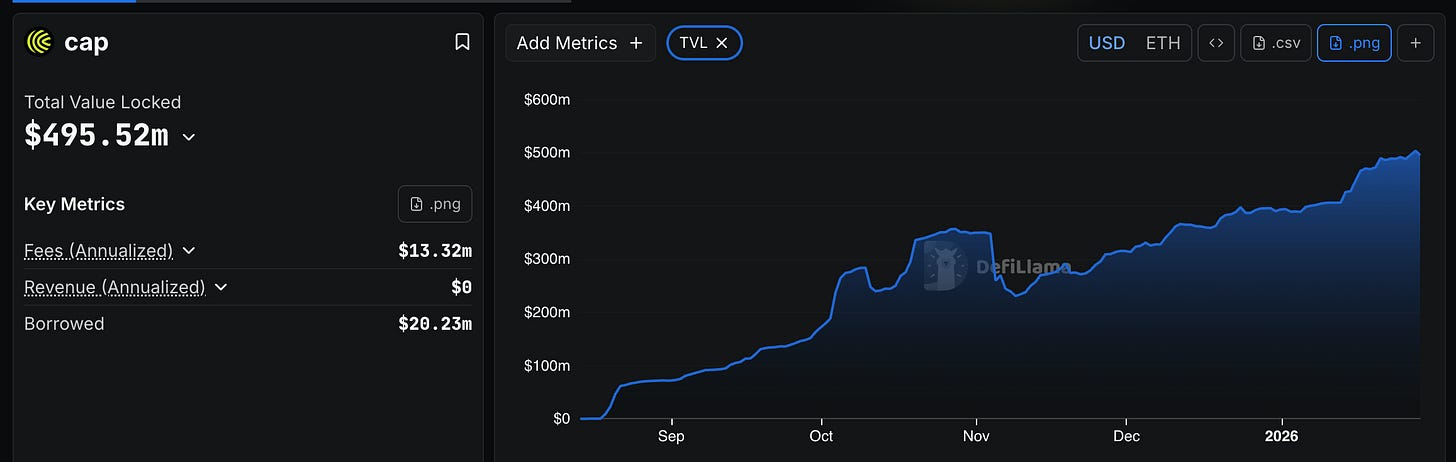
The protocol focuses on institutional-grade yield strategies with an emphasis on capital efficiency. Hitting the half-billion mark during a generally risk-off period suggests sticky capital that isn’t just chasing short-term farming incentives.
More stablecoin news: Nomura-backed Laser Digital applied for US national trust bank charter, Bitwise registered a spot Uniswap ETF in Delaware, and Frax teased frxUSD’s return to DeFi.