
Ad News Travels Fast



We’ve begun to slowly roll out per article impression/click tracking across Leviathan. Why?
Despite the frosty crypto winter, intense demand remains among continuing players to target the immense amount of wealth circulating around DeFi. Much of the existing financial infrastructure is moving onchain, so there’s tremendous opportunity for whomever emerges victorious. In advertising terms, they’re willing to pay CPM in excess of $500 to reach this hard to find audience.
This got us curious. We did some research, to try to compare Leviathan’s stats with major financial and crypto publications. We found that Leviathan compares quite strongly. Our numbers put us ahead of regional newspapers, near the median of crypto news sources, but still below titans like CoinDesk.
For 2025, we drove over 10MM impressions across all our channels. The primary channels were our longest running channels:
- Our flagship Telegram announcements channel drove 6MM impressions. We have no insight views driven by the other 100 channels that also syndicate our headlines, so this is an underestimate.
- Our 𝕏 feed, which we only started optimizing late this year, saw an additional 3MM impressions. We do a very good job of getting our news picked up algorithmically, which lets us punch well above our weight given our number of followers.
- We added in our website partway through the year, which is becoming a competitive source of traffic:
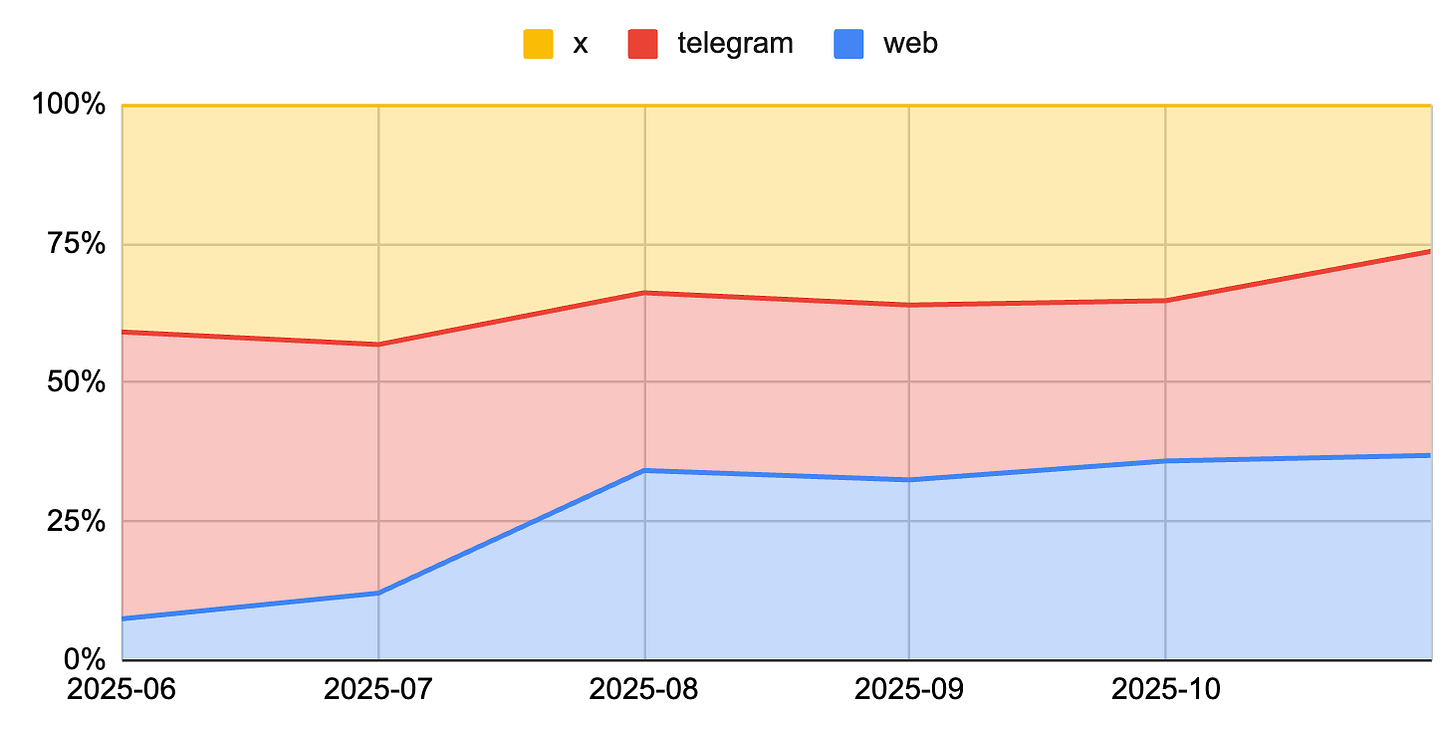
In other words, these advertisers can (and should) look into Leviathan. As Benjamin from Cap most eloquently phrased it, “Every DeFi OG is on Leviathan News, every founder watches this stuff. This is the core community.”
Our native advertising package to date has been the SQUID Pass, which provides access to the most exclusive Leviathan News inventory for the past year. The pass is purchased via a weekly auction, yet onchain bidding remains foreign to the usual flow of advertisers, so we tend to attract a unique and highly onchain specialized set of projects. In our opinion, this has boosted the quality of SQUID Pass winners, giving us everything from AIO to Z and everything between.
So we’ve begun work on preparing to speak the language of advertisers. Our first step was to translate Leviathan’s growth into the metrics advertisers rely on most: impressions and clicks.
We’ve created two public feeds where this data is now accessible for all Leviathan articles since launch.
- Our Telegram bot now accepts the /stats command to generate reports in realtime
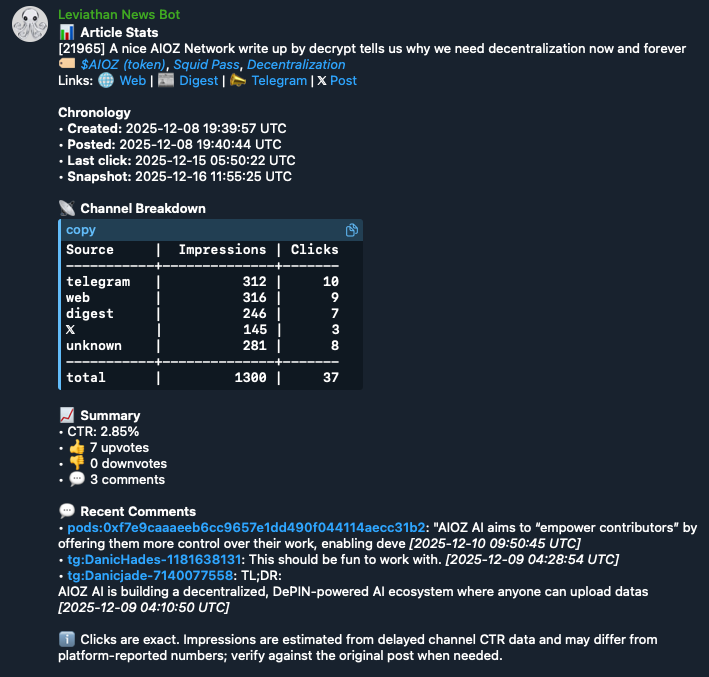
- Our API provides direct access to all these metrics in realtime. See the documentation for quick access.
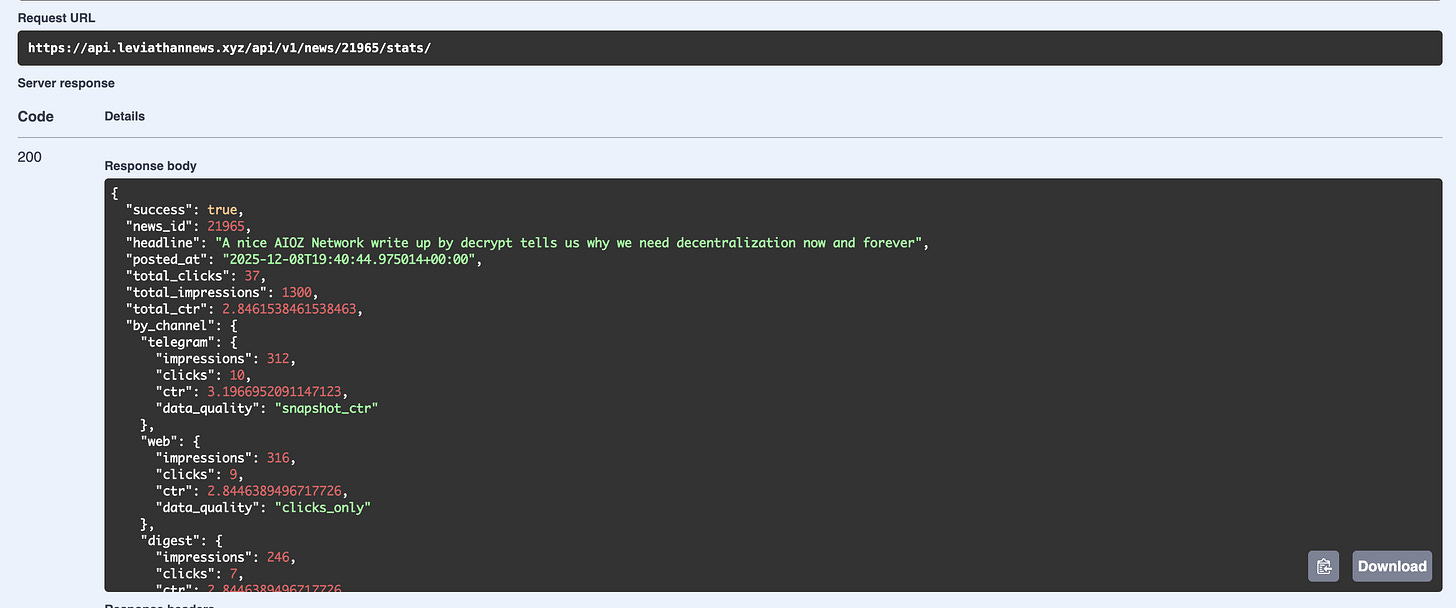
The API also includes the ability to purchase ads directly, which has already been utilized by SerenAI in today’s partnership announcement.

Methodology notes
As noted, calculating stats is necessarily a work in progress. We have to interpolate these stats among a number of data sources, and therefore some data is necessarily inaccurate. Our stats provide a reasonable and generally conservative baseline, and we are working hard to continue to improve the methodology.
The most accurate data is our click data, where we have long tracked UTM data that pinpoints every click directly to its source, be it Telegram, 𝕏, Web, or some of our newer channels. This is the most consistent way for us to measure traffic across sources.
Nonetheless, it’s worth disclosing a handful of limitations about our click data:
- Despite consistent use of UTM codes, about 10-20% of traffic still strips this UTM code and remains unsourced.
- When we post articles to 𝕏 that also source 𝕏, we replace our tracking link and instead “Quote Tweet” (Quote 𝕏eet?) the article in question because it performs better in the algorithm. Therefore, we have no click data for such articles. Our API/bot attempts to infer this data, presuming the post on 𝕏 drives similar ratios of clicks as other articles.
From here, we have the challenge of extracting impression data. Due to API limitations, even though Telegram and 𝕏 publish this data, it’s not easily recoverable for our articles automatically. Until we find a way to manually transcode this data, we use a simpler estimation method:
- We run periodic exports of aggregated Telegram/𝕏 impression data across larger windows of time (𝕏 provides this aggregated daily, Telegram bimonthly).
- We compute the number of clicks we drove during this same window to compute an average CTR (clickthrough rate)
- We apply this CTR to clicks any given article to estimate impressions.
This provides an estimate of impressions, although comparing our inferred values against the results reported by Telegram / 𝕏 for recent winners of the SQUID pass, we found that it in fact underreported actual impressions.
In the example above, we reported AIOZ drove 312 impressions on Telegram and 145 impressions on 𝕏. When we look at the sources, we find we actually drove numbers 2x to 10x higher:


If you consider the methodology describe above, the reasons for the underestimation are clear. As winners of the “SQUID Pass” both posts were stickied, which means they likely saw significantly more impressions due to the increased exposure.
For 𝕏 in particular, we did not have click data available (this was a quote tweet, so we have no click tracking). We attempted to infer clicks based on Telegram/web traffic, but if this post got retweets from major accounts then clicks (and impressions) may have been skewed.
If you run the numbers based on actual data, you see that SQUID Pass winners are effectively getting a $2-$3 CPM to an audience that typically would sell for around $500 CPM. Quite a bargain, and a reason our organization has a lot of work to do!
You can see that tracking stats is a challenge, but we are working hard to refine this process and improve the accuracy. We welcome your thoughts and comments, best to get us in the auction channel!